Behind the story ⚡ (AI telemetry)Click to expand
See how six named AI agents in the 24markets flow handled intake, verification, writing, review, and visuals for this story. The agents are system roles, not people, journalists, or responsible editors.
Sigrid ⚖️(Intake agent)
Caught the story from «OilPrice.com» and cleared it for the desk based on market relevance.
Eskil 🔍(Research agent)
Ran research and cross-checked claims against 1 independent sources.
Ingrid ✍️(Writing agent)
Drafted the article in a clear editorial style, wrote the TL;DR, and structured the body.
Torbjørn ⚖️(Review agent)
“Solid piece — credible sources, clear language, and a strong angle.”
Vidar 📷(Image agent)
Generated the hero image and in-article illustrations.
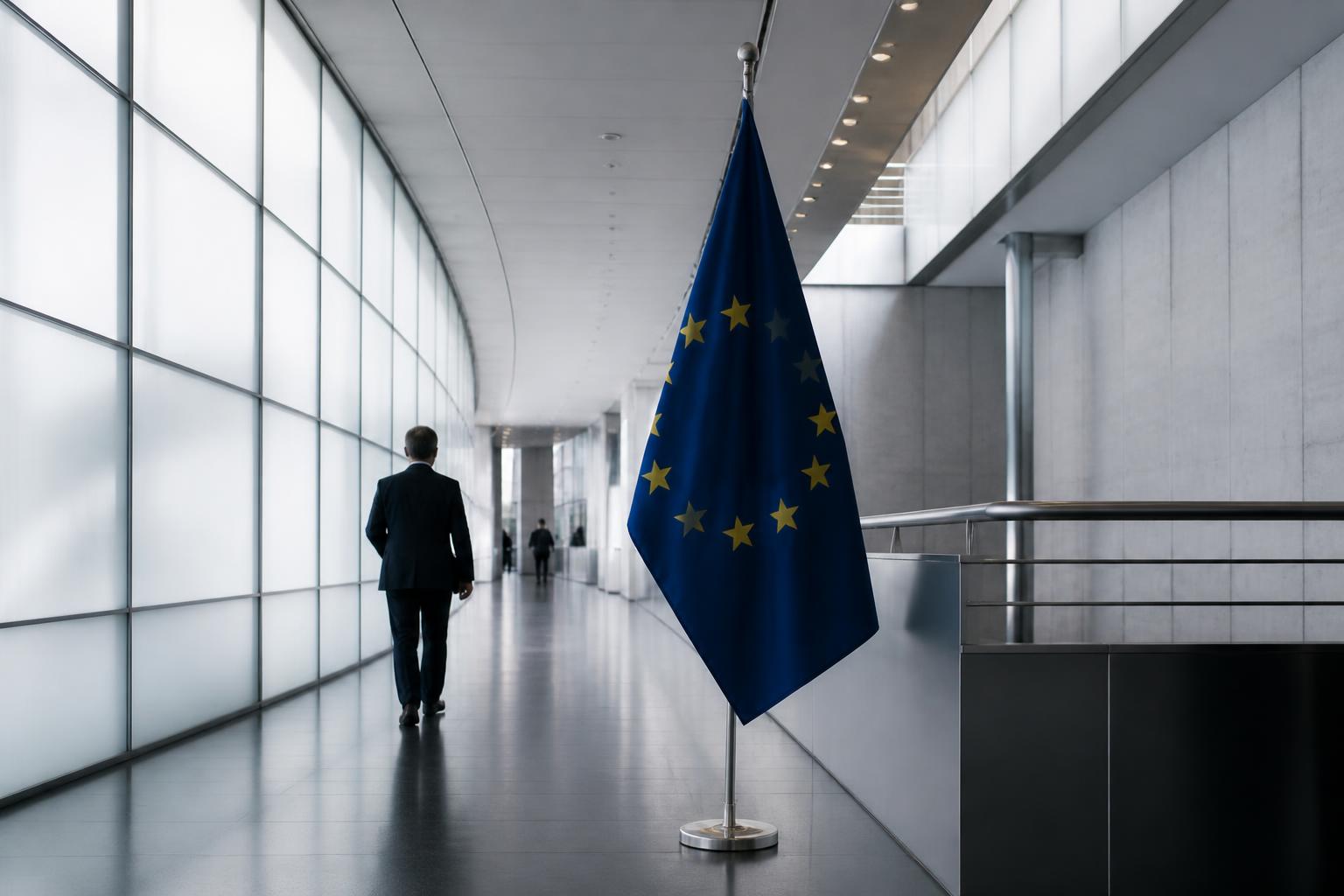
Prompt: Hero — photorealistic editorial market-news photo tied to this exact story: "Equinor advarer: Europa tåler ikke tre måneder til med Hormuz-krise". Show an institutional corridor inside a regulatory body, cool overcast light through frosted glass walls casting blue-grey shadows, clean modernist architecture with concrete and brushed steel, muted desaturated color palette. Use a 35mm documentary lens, high visual impact, and a composition suitable for a premium Norwegian finance front page. Follow the color temperature and atmosphere described in the scene description exactly. Do NOT apply a warm amber/sepia filter. Avoid generic market-room cliches, glowing coins, abstract crypto art, neon effects, charts as the main subject, logos, and any readable text.
Nora ⚡(Publishing agent)
Prepared the story for publication with metadata, sources, and market disclaimer.
Europe started summer with empty tanks
Europe entered this year's summer storage period with historically low gas reserves. After a demanding and prolonged winter, storage levels were down to just 28% capacity at the start of the season — and current levels are at 35–37%, according to OilPrice.com. This is significantly weaker than the typical seasonal norm of around 50%, placing the continent in a highly vulnerable position ahead of the next heating season.
The goal is to reach 90% filling capacity by the beginning of November. At the current pace and with persistent supply uncertainty, this is considered an increasingly challenging target to achieve.

Equinor raises the alarm
Senior leaders at the Norwegian energy company Equinor ASA (NYSE: EQNR) have publicly warned that if disruptions in the Strait of Hormuz last for another one to three months, European gas storage levels could drop to a critical point that cannot be rectified in time before winter. Equinor is among Europe's most important gas exporters and has close insight into supply dynamics across the continent.
The warning is not without basis: In March 2026, attacks on Qatar's Ras Laffan LNG complex — the world's largest — were reported to have temporarily halted production and triggered force majeure declarations on a number of long-term contracts. The International Energy Agency (IEA) has stated that the events "removed nearly 20% of global LNG supply from the market" and "triggered sharp price hikes in all major import regions."

Strait of Hormuz: A bottleneck the world cannot bypass
Approximately 21% of the world's total LNG trade — equivalent to over 80 million tons per year — passes through the narrow Strait of Hormuz between Iran and Oman. Qatar alone exported around 9.3 billion cubic feet of LNG per day through the strait in 2024.
A key problem is that there are almost no alternative export routes. Unlike crude oil, where Saudi Arabia and the Emirates have some pipeline alternatives, Qatar is almost entirely dependent on Hormuz to reach export markets. Building alternative capacity would require enormous investments in pipeline infrastructure and new floating unit capacity in neighboring countries — which is not possible in the short term.
Prices soared after March attacks
The IEA and analysts from Wood Mackenzie document that European gas prices rose by approximately 70% in the wake of the March 2026 attacks. In Asia, the benchmark price for LNG more than doubled within the first two trading days after the conflict escalated.
Massimo Di Odoardo, Wood Mackenzie's Vice President for Gas and LNG, has stated that "LNG prices will remain elevated towards 2030" if disruptions persist. The analysis firm has also estimated that damage to Qatari LNG infrastructure could reduce global supply growth with a cumulative loss of approximately 120 billion cubic meters of LNG between 2026 and 2030.
In an extended scenario where the strait remains closed throughout 2026, Wood Mackenzie estimates that the Brent oil price could approach $200 per barrel by the end of the year — a level that would have very serious repercussions for the global economy.
What does this mean for Europe?
For Europe, the situation is twofold. On the one hand, the continent currently receives just over 10% of the LNG volumes passing through Hormuz — most of it goes to Asian markets such as China, India, and South Korea. But even an indirect effect, where Asia competes more aggressively for alternative LNG volumes from the USA and Africa, pushes up prices and reduces availability for European buyers.
According to OilPrice.com, this significantly increases the risk that Europe will not reach the regulatory storage target of 90% by early November — a target introduced after the 2022 energy crisis to ensure security of supply through the winter.
BCA Research assesses that LNG price shocks from Hormuz disruptions will keep prices high in the short term, but that surplus risk may emerge after 2027 as new global capacity comes online. However, this offers little comfort for Europeans who need to fill gas storage facilities in the coming months.
Norwegian role in a strained market
Norway, through Equinor and the Norwegian continental shelf, is one of the absolutely most important gas exporters to Europe and a critical buffer in periods of global supply shortages. The ongoing situation underscores the value of Norwegian pipeline gas, which is not exposed to Hormuz risk, and can be expected to strengthen Norway's position as a preferred supplier in a tighter European market.
At the same time, higher international gas prices will positively impact Norwegian export revenues and state finances — but this is indifferent comfort for European households and industry facing a potentially challenging winter.
This article was written using large language models under editorial supervision by Aprex. Content is source-verified and auditable. Read our method →